AI impact on Indian IT sector showing market correction and technology disruption

From Cash Cows to Code Red? The Wake-Up Call for Indian IT

In recent weeks, India’s IT sector, long regarded as the economy’s dependable backbone, has entered turbulent waters. 

The Nifty IT index has fallen nearly 17% over the past month, marking one of its sharpest short-term selloffs in years and significantly underperforming broader market benchmarks.

Markets call this a correction. But beneath the surface lies a deeper question!!!

Dividend Payouts vs Digital Breakthroughs

Indian IT firms have been phenomenal cash-generation engines. Companies such as TCS, Infosys, HCL Technologies, Wipro and Tech Mahindra consistently delivered strong return ratios, robust balance sheets, and generous shareholder payouts via dividends and buybacks.

Between FY20 & FY25, India’s top five IT firms returned ~ 4.8 Tn to shareholders, i.e., 87% of their combined net profits.

TCS alone distributed nearly 99% of its earnings, underscoring how mature and cash-rich the sector had become. In 2025 alone, Infosys announced one of its largest-ever buyback programs 18,000 crore at 1,800 per share highlighting the sector’s continued emphasis on returning capital to shareholders.

While this capital discipline rewarded investors, it also raises a strategic question about how much was reinvested to future-proof these companies in an AI-driven technology cycle.

The R&D Divide: India vs. The World

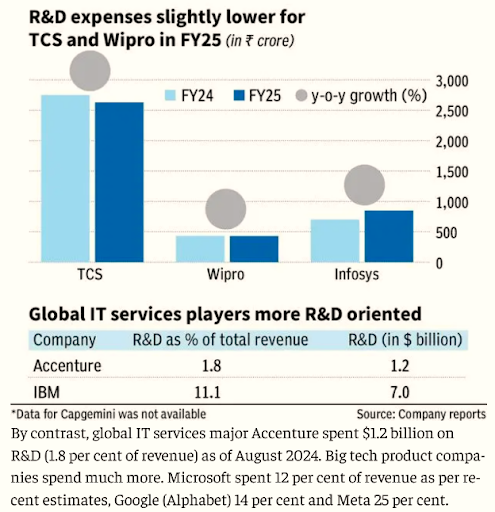
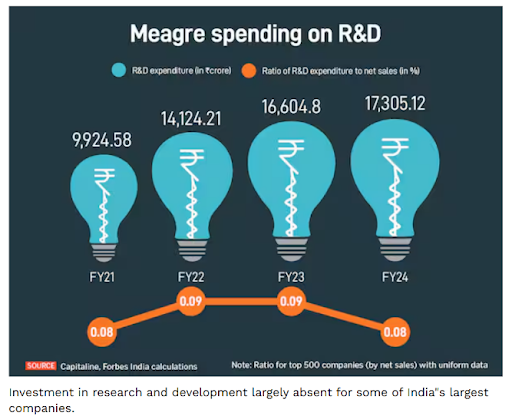
One of the starkest gaps in the global technology landscape is research and development intensity.

Indian corporates across sectors traditionally invest little in formal R&D. Recent analysis shows that the share of total corporate R&D spending by the Indian IT-software sector declined from 4% in FY21 to under 3% in FY24.

Source: Business Line
Source: Forbes India

By contrast, global tech giants plough double-digit percentages of revenue back into R&D:

  • Microsoft: ~13–14%
  • Alphabet (Google): ~15–16%
  • Meta: ~20%+
  • Amazon: ~10–12%

These figures underscore a strategic difference: 

Owning technology stacks versus delivering services on them.

That gap becomes critical when competition shifts from integration to innovation powered by AI and automation.

AI: Threat or Opportunity?

The current sell-off is partly driven by AI anxieties and fears that generative AI could automate key services upstream in coding, testing, maintenance and support, which have been core revenue drivers for Indian IT. 

While Indian firms are now actively partnering with cloud and AI leaders and incubating internal capabilities, the structural economics of services may be altered if AI significantly compresses human effort per project.

The traditional pyramid staffing model, i.e., charging per developer hour could weaken if AI tools handle code generation and testing at scale.

This is not an existential threat. It is a transformational one.

Firms that fail to evolve from people-led services to AI-driven solutions risk:

  • Margin compression
  • Client share erosion
  • Strategic irrelevance

More Than Market Moves – Real Economic Impact

Indian IT is not just another sector. It is a macroeconomic multiplier.

  • Contributes ~7.3% of India’s GDP
  • Employs ~5.8 million professionals directly
  • IT services are the backbone of India’s services exports, contributing ~$224 billion in FY25 and accounting for nearly 58% of the country’s total services exports.

These figures underscore the systemic significance of IT to employment, exports, foreign exchange earnings, and consumption. Cities like Bengaluru, Hyderabad, Gurugram, and Pune have been reshaped by IT jobs, fuelling real estate demand, auto sales, urban consumption and credit growths

A structural slowdown via hiring freezes, wage moderation or layoffs would ripple outward:

  • Lower discretionary spending
  • Pressure on housing demand
  • Slower consumption growth
  • Potential stress in banking and NBFC credit cycles

Remember, Market corrections hurt portfolios. Economic slowdowns hurt livelihoods.

What Mutual Funds and Investors Are Exposed To?

Many large-cap mutual funds and SIP portfolios are implicitly overweight in the Indian IT sector. A recent Mint study shows that the IT sector accounts for over 10% of holdings in top mutual funds, leaving investors more exposed than they may realize. 

Retail investors who began SIPs in the last two to three years may not have fully priced in the structural risks of AI-led disruption and capital allocation trade-offs, raising the possibility that prolonged IT underperformance could drag down market-cap weighted funds and cause SIP returns to lag broader, multi-sector benchmarks.

Conclusion: The Capital Allocation Conundrum

This is not an indictment but a strategic paradox.

Indian IT firms have delivered consistent shareholder returns and strong governance. But did that discipline translate into future competitiveness?

Arguably, Western tech majors chose the “reinvent the core” path. Indian services majors chose the “perfect the delivery model” path.

In the era of AI, platform leverage often trumps execution leverage. 

Indian IT may navigate this transition, finding fresh service layers to monetise AI for clients. Indeed, many firms are already pivoting and upskilling.

Disclaimer: The above content is for knowledge purpose only and under no circumstances is the information therein to be used or considered as constituting an offer to buy or sell, or solicitation of any offer to buy or sell or recommendation to acquire or dispose of any security, commodity or investment or to engage in any other transaction.

Leave a comment